

Choose perfume oil when you want a scent that stays close to your skin for hours; choose spray when you want an entrance. Oil formats trade projection for longevity and intimacy, while alcohol-based sprays trade some staying power for immediate, room-filling presence. For the office, oil wins; for a night out, spray does. Layer both, and you get the best of each.
TL;DR:
- Oil-based perfumes last longer on skin, typically 6 to 10 hours, especially when skin is moisturized, unlike sprays that last 4 to 8 hours.
- Sprays provide immediate, room-filling projection suitable for events where visibility is desired, while oils stay close to the skin, making them better for intimate settings.
- Proper application involves pressing oil onto pulse points and waiting before layering, with spray held 5 to 10 centimeters from skin, avoiding rubbing.
- Sensitive skin benefits more from oil, but reactions depend on specific ingredients, so patch testing remains essential for both formats.
- Cost per wear favors oils due to minimal usage, and oils’ packaging and lower environmental impact appeal to travelers and eco-conscious consumers.
Table of Contents
- Perfume oil vs spray: how carriers and concentration shape performance
- How long each format lasts and how far it travels
- How to apply perfume oil (and spray) without wasting it
- Is perfume oil better for sensitive skin?
- Cost, travel and the sustainability side of oil vs spray
- A quick way to choose between oil and spray
- Rook Perfumes’ take on formulation and how to trial scents
- Why the “one is objectively better” debate misses the point
- Try Rook: how to sample both formats without committing blind
- Sources
Perfume oil vs spray: how carriers and concentration shape performance
The carrier is the whole story here. Perfume oil suspends aromatic compounds in something like jojoba oil or fractionated coconut oil, both of which are thick, slow to evaporate, and reluctant to leave the skin. Spray perfumes suspend the same kind of aromatic materials in ethanol, which is thin, volatile, and built to lift scent molecules into the air the moment it touches skin.
A 2026 comparative study measuring both formulations directly found the physical gap between them is substantial. Oil-based mixtures showed a viscosity of 2.49 against just 0.29 for alcohol, and spreadability of roughly 50 gcm min⁻¹ compared with 300 for alcohol. The comparative evaluation of oil and alcohol carriers also found oil scored higher on sensory adhesion and longevity, while alcohol scored higher on spreadability and initial intensity. Thicker liquid clings; thinner liquid spreads and vanishes faster, carrying scent with it as it goes.
This explains why identical fragrance oils can smell like two different products depending on delivery method:
- In oil, top notes fade faster because there’s less alcohol lift, so the composition often reads warmer and more linear from the first minute.
- In spray, the alcohol flash carries volatile citrus and aldehyde notes straight to your nose, giving a brighter, louder opening that fades as the alcohol evaporates.
- Concentration labels (EDT, EDP, parfum) still apply within the spray category, but oil sits outside that scale entirely since it’s rarely diluted the same way.
The result is that “strength” on a bottle only tells half the story. Carrier choice matters as much as concentration percentage.
How long each format lasts and how far it travels
Oil-based fragrance typically lasts longer on skin than spray, often running 6 to 10 hours or more on well-moisturised skin, while an eau de parfum spray tends to sit closer to 4 to 8 hours before fading below detection. Those ranges shift constantly depending on your skin type, the room temperature, and how much product you actually used.
On skin chemistry: dry skin burns through fragrance faster than hydrated skin because there’s nothing to slow the evaporation of the oils holding the scent. A dab of unscented moisturiser before applying either format extends wear noticeably.
Projection follows the opposite pattern. WhatScent’s comparison of the two formats notes that sprays create a distinct, noticeable sillage because alcohol evaporates quickly and pushes volatile top notes outward, while oil stays close enough to the skin that only someone within arm’s reach will catch it. That makes spray the better pick for entrances, dates, or evenings where you want to be noticed across a room, and oil the better pick for meetings, shared offices, or anywhere a loud scent would be a liability.
Four variables decide how either format performs on any given day:
- Skin hydration — moisturised skin holds fragrance longer than dry skin.
- Climate — heat and humidity speed up projection and shorten wear time for both formats.
- Fragrance family — heavier bases (resins, musks, woods) outlast citrus and aquatic notes regardless of carrier.
- Application amount — more product doesn’t always mean longer wear; overapplication can actually distort a composition.
How to apply perfume oil (and spray) without wasting it
Oil and spray need entirely different dosing logic, and using spray habits on oil (or vice versa) is the single most common mistake fragrance buyers make.
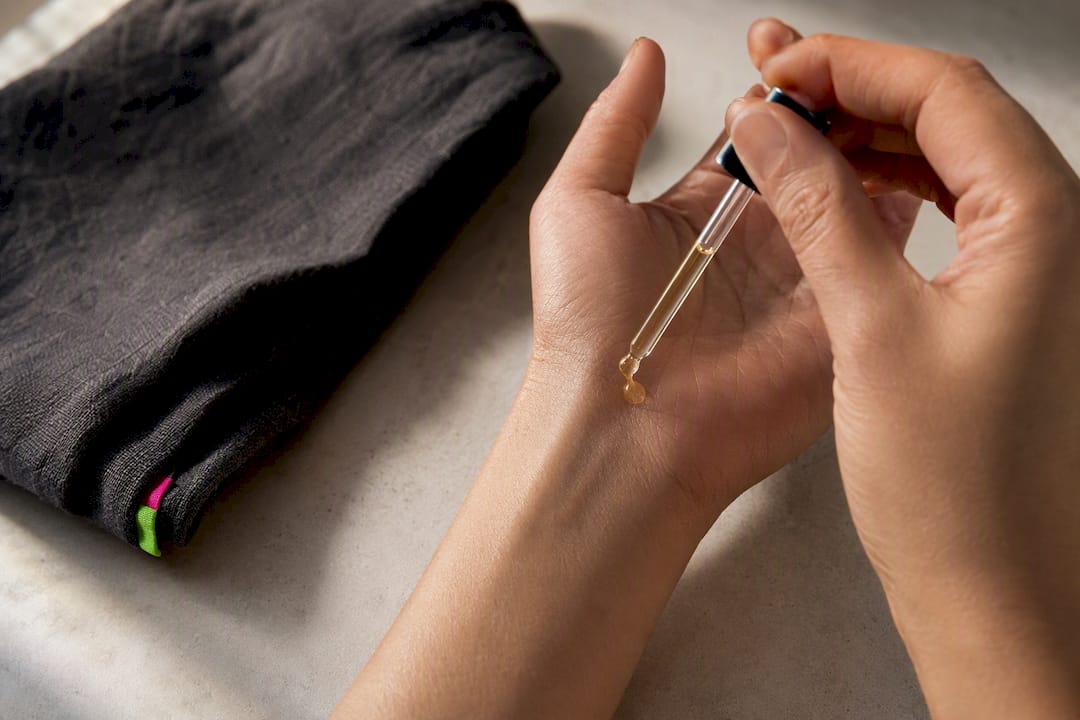
For oil, 1 to 3 drops is the working range for most concentrated blends. Because oil doesn’t evaporate the way alcohol does, there’s no “top up” moment. Perfume On Skin’s application guidance recommends pressing the oil into pulse points rather than rubbing it in, since rubbing generates friction heat that can break down the top notes before they’ve had a chance to develop.
For spray, 1 to 3 sprays on pulse points covers most eau de parfum concentrations, and this is where the so-called “5-spray rule” comes from: a guideline built specifically around alcohol’s evaporative behaviour and how many sprays it typically takes to build sillage without overwhelming a room. It has no equivalent for oil, because oil doesn’t rely on evaporation to project in the first place.
A simple, repeatable routine:
- Moisturise skin with an unscented lotion first, especially before oil.
- Apply oil to pulse points (wrists, inner elbows, base of throat) using a fingertip, pressing rather than rubbing.
- Wait 5 to 10 minutes before layering a second product over it.
- For spray, hold the bottle 5 to 10 centimetres from skin and apply to the same pulse points.
- Avoid rubbing wrists together after either application; it disturbs the scent’s natural development.
Pro Tip: Test any new oil or spray on one wrist first and wait an hour before deciding it’s “too weak” or “too strong”. Oils in particular open slowly, and what smells faint at minute five can be perfectly present by minute thirty.
Is perfume oil better for sensitive skin?
Often, yes, but not automatically. Alcohol-based sprays can dry out skin and trigger stinging or redness in people prone to eczema or general sensitivity, since ethanol strips surface oils on contact. Oil formats skip that irritant entirely, which is why they’re frequently recommended for drier or more reactive skin types.
That said, oil isn’t a free pass. The fragrant raw materials themselves, not just the carrier, can still cause allergic reactions regardless of format. Switching from spray to oil won’t help if the reaction is to a specific aromatic compound rather than the alcohol.
A few practical safeguards:
- Patch-test any new fragrance, oil or spray, on the inner elbow and wait 24 hours before applying it more widely.
- If sprays consistently irritate you, try the same scent family in oil form before assuming you’re allergic to the fragrance itself.
- Apply oil over an unscented moisturiser rather than directly onto bare skin if you notice any tightness or dryness.
- In medical settings, shared offices, or scent-restricted spaces, oil’s lower projection makes it the more considerate choice by default.
Cost, travel and the sustainability side of oil vs spray
Perfume oil often wins on cost per wear simply because you use so little of it. A 10ml bottle at 1 to 2 drops per application can outlast a 50ml spray bottle used at 3 to 4 sprays a day, even though the oil bottle looks smaller on the shelf.
Travel favours oil too, for a different reason: roll-ons and dab bottles aren’t pressurised, so they sail through airline liquid restrictions more easily than aerosol sprays, and they’re far less likely to leak in a washbag.
The trade-offs worth knowing before you pack one in a suitcase or dab it onto a shirt:
- Staining risk — oil can mark light fabrics, so apply it to skin rather than clothing; spray is generally safer for garments once it’s dry.
- Packaging footprint — oil bottles tend to be smaller and use less glass and plastic per wear than pressurised spray bottles.
- Carrier sourcing — jojoba and coconut-derived carriers vary in sustainability depending on farming practice, so no format gets an automatic environmental pass.
A quick way to choose between oil and spray
Three questions settle most decisions in under a minute.
- Do you need projection or intimacy? If people three feet away should notice, pick spray. If only you (and anyone close) should catch it, pick oil.
- What’s the setting? Office, hospital, shared transport: oil, at 1 to 2 drops. Evening event, date, night out: spray, at 2 to 4 sprays.
- Is your skin dry or reactive? Dry or sensitive skin usually does better with oil layered over moisturiser; robust, well-hydrated skin can handle either format equally well.
One red flag either way: if a scent still feels overpowering ten minutes after application, you’ve used too much, not too little. Before buying, check whether the fragrance is sold in both formats. If so, a discovery set is the cheapest way to test both on your own skin before committing to a full bottle.
Rook Perfumes’ take on formulation and how to trial scents
Formulation choices around carrier, concentration, and ingredient sourcing sit at the centre of how Rook Perfumes approaches making a perfume. The brand builds its scents around memory and story rather than trend-chasing.
Ingredient-driven sensitivity matters here too. Anyone reacting badly to a spray might do better investigating the role of musk in perfumery before assuming alcohol is the culprit, since musk and other base notes can themselves trigger sensitivity regardless of carrier.
Matching Rook’s range to the format decision above:
- Ambient/room formats suit anyone prioritising a space over personal wear rather than skin longevity.
- Eau de parfum concentrations suit anyone who wants a long-wearing, rich composition applied directly to skin.
- Room sprays suit anyone who wants scent in a space without wearing fragrance on their body at all.
The fragrance discovery sample sets remain the lowest-friction way to test how a Rook composition behaves across formats before buying a full bottle.
Why the “one is objectively better” debate misses the point
Most arguments about perfume oil versus spray assume there’s a winner. There isn’t, and the 2026 physicochemical data backs that up precisely because it measured two different jobs, not two competing versions of the same job. Oil is built for adhesion and slow release; alcohol is built for spreadability and immediate intensity. Comparing them for “which lasts longer” without asking “longer at doing what” is where most buying advice goes wrong.
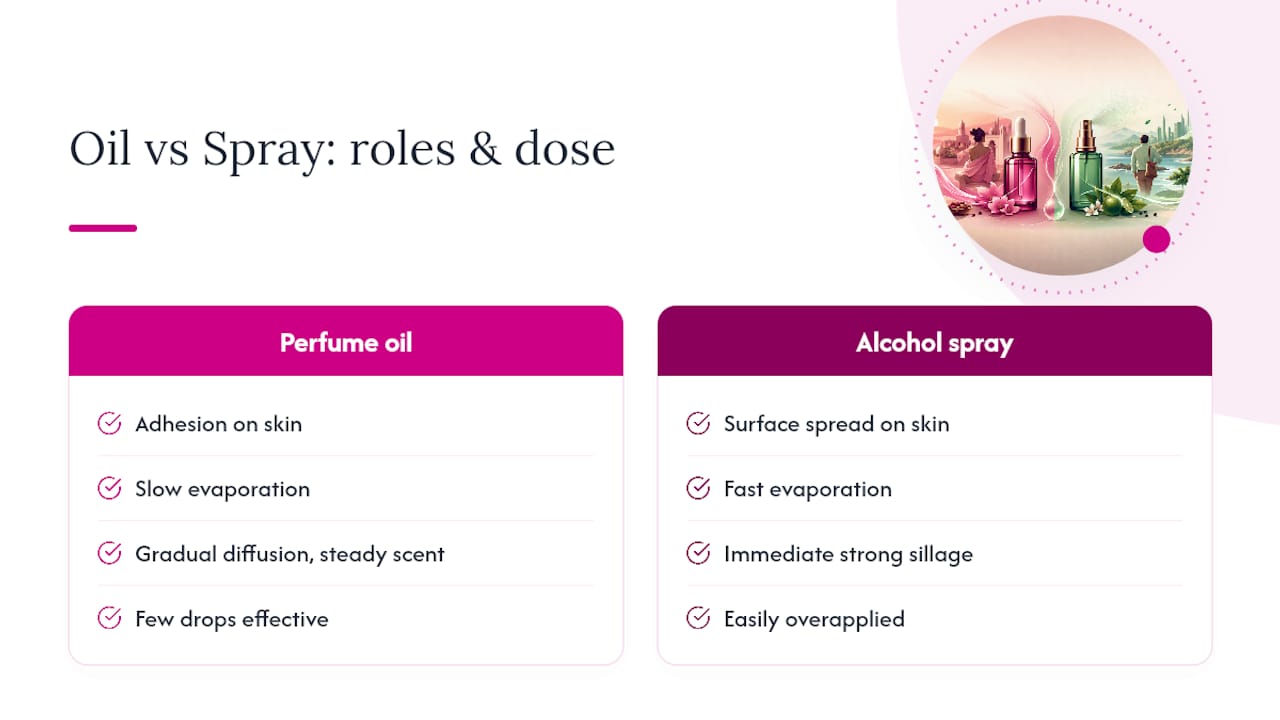
The bigger blind spot is dosage, not format. People overapply spray because the 5-spray heuristic gets repeated without context, and they underapply oil because a few drops feels like it “can’t be enough” compared with a visible mist. Both instincts are backwards. Sillage from spray fades in an hour regardless of how many extra sprays you add, and oil’s slow release means two well-placed drops on moisturised skin will consistently outperform four drops rubbed in carelessly.
If you take one thing from any oil versus spray comparison, take this: match the format to the room you’re walking into, then get the dose right for that format specifically. Everything else is preference.
— Rook
Try Rook: how to sample both formats without committing blind
If projection and room presence are what you’re after, the Rook Ambient Spray Scent One delivers a Middle Eastern inspired home fragrance built to fill a space rather than sit on skin.
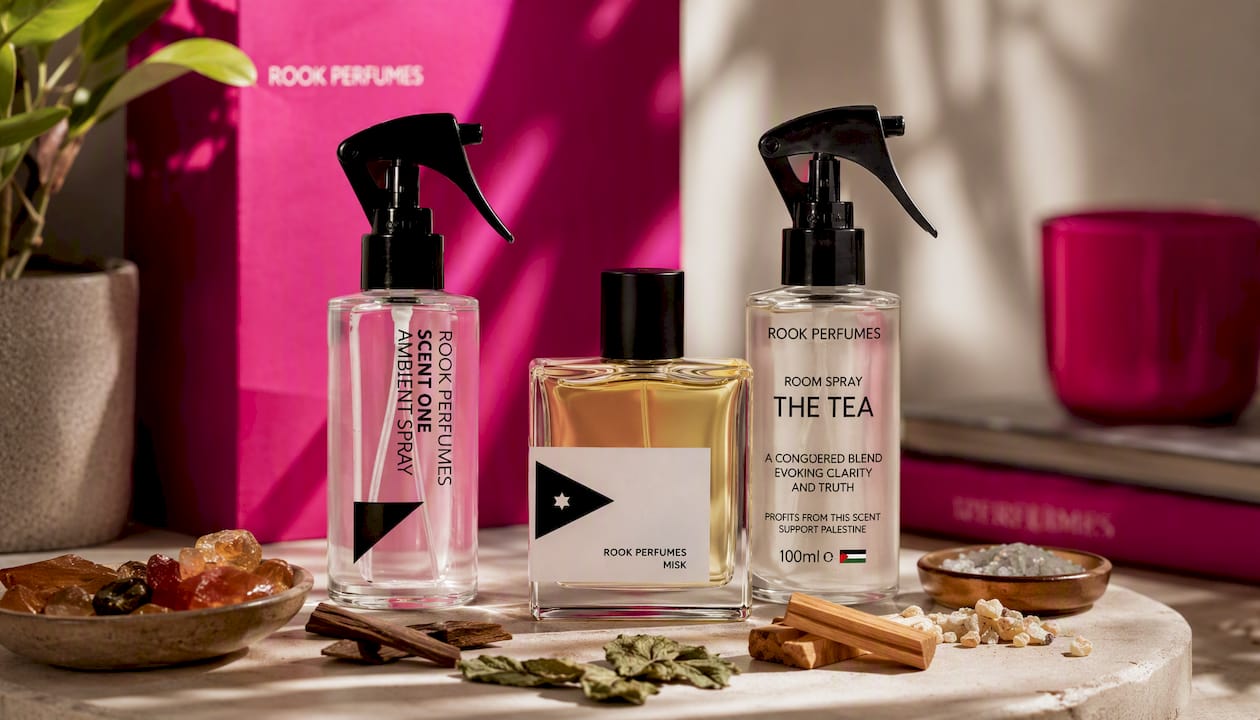
For long-wearing, skin-close scent, Misk Eau de Parfum leans into patchouli and musk for a composition designed to develop slowly over hours rather than announce itself instantly. And if you want fragrance in a room without wearing anything at all, THE TEA room spray offers exactly that: ambient scent, zero skin contact, zero dosage guesswork.
Unsure which carrier or concentration actually suits your skin and setting? The fragrance discovery sample sets let you test several Rook compositions side by side, each cruelty-free and unisex by formulation, before you spend on a full bottle. Start there, compare how each one wears on you over a full day, then order the format that actually earned it.
Sources
- Comparative evaluation of oil- and alcohol-based fragrance formulations (IJPAR) 2026
- How to apply perfume oil for better longevity (Perfume On Skin)
- Perfume oil vs spray: Which lasts longer (WhatScent)
0 comments